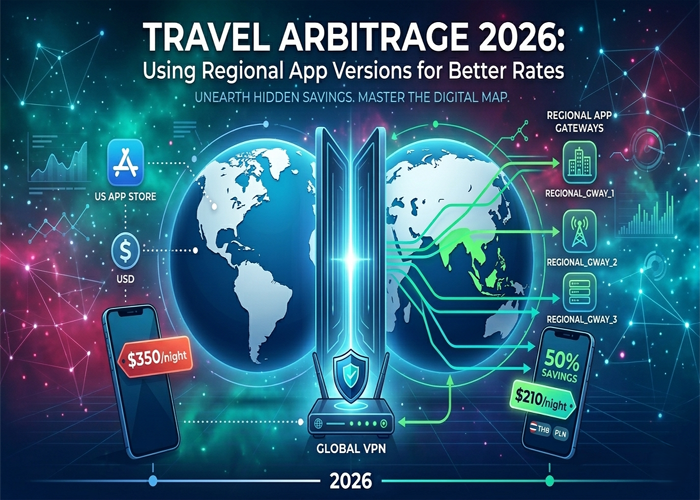
 Travel Arbitrage 2026: Using Regional App Versions for Better Rates
In 2026, the savvy traveler is no longer just looking for a "Good Deal." They are hunting for Travel Arbitrage.
We have entered an era where the price you see for a hotel room in Tokyo or a villa in Bali isn't just about the date or the room type—it’s about your Digital Point of Entry. While most travelers are still using a basic search on their local version of a booking app, the "Arbitrage Class" is exploiting regional pricing disparities to save 30% to 50% on the exact same inventory.
Travel Arbitrage is the practice of exploiting the price differences of the same travel product across different regional markets. In the past, this was done by physically buying tickets in other countries. In 2026, it is done by manipulating how booking platforms—Like Agoda, ZenHotels and Booking.com—perceive your location, currency, and device.
Many people believe that travel sites show the same price to everyone. This is false. Platforms use Dynamic Regional Pricing (DRP) to adjust rates based on:
Purchasing Power Parity (PPP): A user in Zurich is often shown a higher rate than a user in Ho Chi Minh City for the same hotel.
Regional Competition: If Agoda is fighting for market share in Southeast Asia, it will offer "App-Only" or "Regional Secret" deals that are blocked for European or North American IP addresses.
Currency Fluctuations: Real-time exchange rate lag between a platform's central server and its regional gateway can create 2–5% "arbitrage windows."
To succeed at arbitrage, you must understand the "DNA" of the platforms you are using. In 2026, the market is split into two distinct ecosystems.
1. The Eastern Powerhouses: Agoda & Booking.com
As of early 2026, Agoda remains the king of the "Merchant Model" in Asia. Because they buy room blocks in bulk, they have the most flexibility to offer regional-specific discounts.
The Agoda Glitch: Often, using the Agoda Thailand or Agoda Philippines version of the app (via a VPN) reveals "Flash Vouchers" that do not exist on the US or UK versions.
Trip.com (The Flight King): Trip.com has become the dominant player for multi-country Asian itineraries. Their "Member-Only" regional rates for flights are currently the best in the industry for 2026.
2. The Western Giants: Booking.com & Expedia
Booking.com operates primarily on the "Agency Model." While they offer the best flexibility (pay-at-hotel), they are harder to "arbitrage" because the hotel often sets the price. However, their Genius Level 3 discounts are often "stacked" with regional mobile-only deals, creating a double-dip opportunity.
3. The Disruptors: ZenHotels & RatePunk
ZenHotels has gained a massive reputation in 2026 for having "leakage" rates—prices that were meant for travel agents but ended up on the public site. Combining ZenHotels with a price-tracking tool like RatePunk is the "Pro Move" for this year.
Executing travel arbitrage in 2026 requires more than just a VPN. Platforms have become "Smarter" at detecting spoofed locations through Browser Fingerprinting and Deep Packet Inspection.
Before searching, you must clear your "Digital Shadow."
Incognito is Not Enough: Use a privacy-hardened browser or a mobile emulator. Platforms in 2026 can see your battery level and screen resolution to "Fingerprint" you even in Incognito.
The "Flight Mode" Trick: On mobile, turn on Flight Mode, then turn on Wi-Fi while connected to a regional VPN. This prevents the app from using cell tower data to verify your real location.
Not all regions are equal. To find the best rates, you want to "Search From" countries with:
Lower Average Income: Poland, Vietnam, Turkey and Brazil are current 2026 "Value Gateways."
Weak Local Currency: If the Turkish Lira or Japanese Yen is experiencing a dip, searching through those regional gateways can yield massive savings if the platform hasn't updated its "Global Base Rate" for that hour.
This is where most people fail.
Always Pay in Local Currency: If you are booking a hotel in Japan, pay in JPY. Never let the app do the conversion for you; their "Convenience Fee" is usually 3–5%.
Use a 2026 Neobank: Use a card like Revolut or Wise that offers mid-market exchange rates. In 2026, some cards even offer "Travel Cash Back" that stacks with your arbitrage savings.
Destination: A 5-star resort in Phuket, Thailand.
Standard US Search (Booking.com): $340/night.
Agoda (US Version): $315/night.
Agoda (Regional Version - IP set to Vietnam): $245/night + a $20 "Mobile Flash" voucher.
Total Savings: $115 per night (34%).
Is it legal? Yes. You are simply choosing which digital storefront to walk into. However, there are risks:
The "No-Show" Risk: Some regional rates are strictly for residents of that country. While rare for hotels, some "Resident-Only" rates in South America or India can be enforced at check-in. Always check the "Fine Print" for the term "Resident Rate."
Customer Support: If you book through a Vietnamese regional version of an app, your support ticket might be routed to a regional center. Luckily, in 2026, AI-translation in chat support has made this a non-issue.
By late 2026, we are seeing the rise of Agentic Commerce. New AI tools like "OpenAI Operator" or "Google Agentspace" can be programmed to run these 100+ regional searches for you in the background. Instead of you spending 2 hours flipping VPN locations, you simply tell your AI: "Find the lowest regional arbitrage rate for this hotel in Tokyo and book it using my Polish VPN profile."
Travel is a commodity and like any commodity, its price is fluid. In 2026, the difference between a "Standard" traveler and an "Arbitrage" traveler is simply a few clicks and a better understanding of the digital map ??.






💬 Comment Section