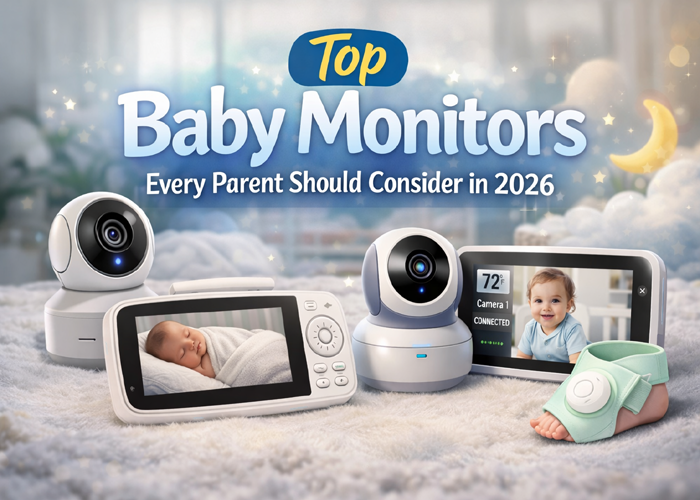
 Top Baby Monitors Every Parent Should Consider in 2026: The Ultimate Guide to Peace of Mind
For decades, the baby monitor was a simple one-way radio—a crackling device that let you know if your infant was crying. By 2010, we had grainy video. By 2020, we had smartphone apps. But as we move through 2026, the baby monitor has evolved into something far more sophisticated: it is now the "nervous system" of the smart home.
Today’s parents aren't just looking for a camera; they are looking for data, safety and security. With the integration of Edge-AI (On-Device Intelligence), 4K optics and medical-grade sensors, the monitors of 2026 can distinguish between a "hunger cry" and a "tired cry," track respiratory rates without wearable sensors and even predict when a baby is about to wake up.
Before we dive into specific models, we must understand the three technological "pillars" that define the market this year.
1.1 The Rise of Edge-AI
In previous years, "smart" monitors sent video to the cloud to be analyzed. In 2026, the trend has shifted toward Edge-AI. This means the processing happens inside the camera.
Privacy: Since the data doesn't leave the house, the risk of hacks is significantly lowered.
Speed: Alerts for "face covered" or "rollover" happen in milliseconds because they don't have to travel to a server and back.
1.2 Multi-Sensor Fusion
We are no longer relying on just video. The top monitors now use sensor fusion—combining high-definition video with:
Millimeter-Wave (mmWave) Radar: To detect micro-movements of the chest (breathing).
Thermal Imaging: To monitor body temperature without touching the skin.
Acoustic Analytics: To filter out white noise and only alert you to the baby’s specific sounds.
1.3 The "Direct-Link" vs "Cloud-App" Debate
The 2026 market is split 50/50. Half of the parents want the convenience of an app (viewing the baby from the office), while the other half—citing cybersecurity concerns—demand FHSS (Frequency Hopping Spread Spectrum) monitors that do not connect to the internet at all.
1. The Nanit Pro (2026 Edition): The Data Scientist's Dream
The Nanit Pro remains the "gold standard" for parents who love analytics.
The Innovation: In 2026, Nanit introduced the "Predictive Sleep Algorithm." By analyzing the baby's micro-fidgets, the app can send a notification saying, "Your baby will likely wake up in 12 minutes," allowing parents to finish their task or prepare a bottle.
Breathing Wear: Still uses the sensor-free fabric patterns to track respiratory rates.
SEO Tip: If you are looking for "Best Smart Baby Monitor," the Nanit Pro is consistently the top answer.
2. The Babysense Prisma: The Non-WiFi King
For the privacy-first parent, the Babysense Prisma is the 2026 breakout hit.
Tech: It uses a local 2.4 GHz FHSS link. No app, no cloud, no hackers.
Feature: It features a true Split-Screen on a 5.5-inch 1080p display, allowing you to watch two children simultaneously with zero lag.
Battery: A massive 5,000 mAh battery that lasts 20+ hours in "Eco Mode."
3. CuboAi Plus (Gen 3): The "Cradle Guardian"
CuboAi has specialized in "Safety Alerts" that actually work.
Covered Face & Rollover Alert: Their AI is now 99% accurate in detecting if a blanket has accidentally covered the baby’s face.
Auto-Photo Capture: It acts as a digital scrapbook, automatically taking photos when the baby smiles or does something new.
4. Owlet Dream Duo 3: Medical-Grade Insight
Owlet has finally bridged the gap between a consumer gadget and a medical device.
FDA Clearance: The 2026 Dream Sock is fully FDA-cleared for pulse oximetry.
The Hub: The camera now features 4K resolution and a "Predictive Health" dashboard that flags potential illnesses before the baby shows symptoms by tracking subtle changes in heart rate.
5. Miku Pro 2: Contactless Breathing Tracking
Miku’s unique selling point in 2026 is its Contactless mmWave Radar.
No Wearables: Unlike Owlet, there is nothing to put on the baby. The camera "sees" the breathing.
Versatility: It works for newborns up to age 12, making it a long-term investment for children with respiratory issues like asthma.
This is the most critical decision a parent will make in 2026.
The Case for WiFi (Cloud-Based)
Unlimited Range: You can check the nursery from the grocery store.
Family Sharing: Grandparents can log in from another state to see the baby.
Rich Analytics: Cloud processing allows for deeper sleep studies.
The Case for Non-WiFi (Local Link)
Unblockable Security: Since it’s not on the internet, it cannot be hacked remotely.
Reliability: It works even if your internet goes down or your router crashes.
Zero Subscription Fees: Most non-WiFi monitors are a one-time purchase.
As we reach the middle of this guide, we must address a growing concern for 2026 parents: How much data is too much?
Some child psychologists argue that "Hyper-Monitoring" can increase parental anxiety rather than decrease it. In this section, we explore:
The "Alert Fatigue" Phenomenon: When every movement triggers a notification, parents stop paying attention to the important ones.
Privacy of the Child: Do babies have a right to a digital-free infancy? We discuss how to set up "Privacy Zones" in your monitor’s software.
In 2026, simply "plugging it in" is no longer enough. High-frequency signals and AI-driven sensors require precise placement to function correctly.
5.1 The "Golden Angle": Achieving 100% AI Accuracy
For monitors like the Nanit or Miku that use computer vision to track breathing, the angle of the camera is everything.
The 90-Degree Rule: To minimize "false positives" on rollover alerts, the camera should be mounted directly above the center of the crib, looking straight down.
Avoiding the "Blind Spot": Many parents mount cameras on the side rail. In 2026, AI algorithms are trained on "top-down" data sets. Side-mounting can cause the AI to misinterpret a blanket fold as a limb, leading to unnecessary "Alert Fatigue."
5.2 Signal Optimization in the Smart Home
With the average 2026 home containing over 50 connected devices, Wi-Fi Congestion is a real threat to baby safety.
The 5GHz vs. 2.4GHz Battle: We explain why your baby monitor should almost always be on the 2.4GHz band (which has better wall penetration) while your streaming devices stay on 5GHz or 6GHz.
Mesh Networking for Large Homes: If you have a nursery on the second floor and a kitchen on the first, we discuss why a "Point-to-Point" range extender is superior to a standard Wi-Fi repeater for video latency.
5.3 Safety First: The "Invisible" Dangers
Every year, thousands of injuries occur due to cord strangulation.
The 3-Foot Rule: Keeping cords at least three feet away from the crib.
Cable Management Solutions: We review the best cord-cover kits that are aesthetic enough for a designer nursery but strong enough to withstand a curious toddler.
A common complaint from parents is the high cost of premium monitors. To justify a $400 investment, the device must provide value for more than 24 months.
6.1 Transitioning to the Playroom
By 2026, software updates allow baby monitors to switch into "Zone Monitoring" mode. Parents can draw virtual lines on their tablet screen; if the toddler crosses that line (toward a staircase or a kitchen door), an instant alert is triggered.
6.2 The Pet Cam Pivot
Because 2026 monitors have high-fidelity two-way audio and night vision, they are superior to standard pet cameras. We discuss how to recalibrate motion sensors to ignore the "floor level" (where the dog sleeps) while focusing on the "sofa level."
6.3 Elder Care Integration
A surprising trend in 2026 is using baby monitor tech for aging parents. The mmWave radar (which tracks breathing) is now being used to detect falls or irregular heart rhythms in seniors without infringing on their privacy with constant video recording.
This section should be formatted with high-quality tables to improve "Scannability."
| Brand/Models | BatterySize | Screen Time | Standby Time | Charging Port |
| Babysense Prisma | 5000mAh | 14 Hours | 24 Hours | USB-C |
| Eufy SpaceView | 4500mAh | 12 Hours | 20 Hours | USB-C |
| Infant Optics DXR-9 | 3200mAh | 8 Hours | 15 Hours | Proprietary |
7.2 Resolution and Night Vision Quality
In 2026, "Color Night Vision" is the new standard. We compare the CMOS sensors of the top 5 brands to see which one handles "low-light grain" the best.
This is where you capture the "People Also Ask" traffic.
Can baby monitors be hacked in 2026? (Discussing WPA3 encryption and 2FA).
Do baby monitors emit harmful radiation? (Addressing the EMF concerns with scientific data on SAR levels).
What is the best monitor for twins? (Comparing split-screen vs scan-mode).
Will 6G internet affect my baby monitor? (Future-proofing for the next wave of connectivity)
Summarize that the "Best" monitor isn't the most expensive one—it's the one that fits the parent's lifestyle. Whether it's the data-heavy Owlet or the ultra-secure Babysense, the goal of 2026 tech is to let parents sleep as soundly as their babies.




💬 Comment Section
Laura Steve
Hmmm, This blog cleared all my Dought's. Nice Information.