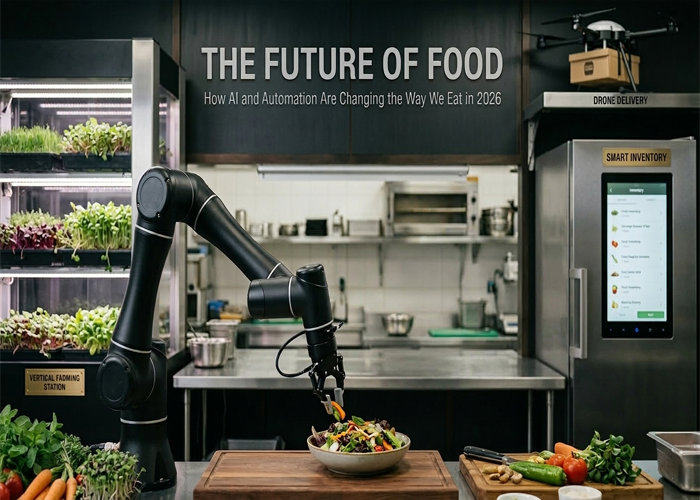
 The Future of Food: How AI and Automation Are Changing the Way We Eat in 2026
By 2026, the global food system has undergone a transformation more radical than the Industrial Revolution. We are moving away from "Mass Production" and entering the era of "Precision Subsistence." For the first time in history, we have the technology to align our biological needs with planetary boundaries, all powered by a layer of Artificial Intelligence that oversees the journey from seed to stomach.
The farm of 2026 is a data center with dirt. The "Intelligent Acre" uses a network of IoT sensors and satellite imagery to treat every individual plant as a unique data point.
2.1 Autonomous Crop Management
Gone are the days of broad-spectrum pesticide spraying. Modern 2026 farms utilize Swarm Robotics. Small, autonomous ground vehicles roam the rows, using laser-weeding technology to "zapping" invasive species without a single drop of chemical herbicide.
2.2 The Digital Twin of the Farm
Farmers now manage "Digital Twins"—virtual simulations of their land. AI runs thousands of "what-if" scenarios: What if the rain is 10% lower this July? What if a specific pest migrates three weeks early? This allows for proactive rather than reactive farming.
In 2026, the kitchen is no longer a place of manual labor; it is a place of assembly and artistry.
3.1 Commercial Scale: The Robotic Line Cook
In the fast-casual sector, automation has achieved 99.9% consistency. Robotic arms handle the high-heat, high-risk tasks. This isn't just about efficiency; it’s about safety. These machines monitor internal temperatures with infrared precision, virtually eliminating foodborne illnesses.
3.2 The Home Revolution: Smart Ovens and Beyond
The 2026 home kitchen features the AI-Sommelier and Chef. Ovens now come equipped with internal cameras and neural networks that recognize over 5,000 ingredients. You don't set a temperature; you simply put the food in and tell the AI, "Make this medium-rare with a crispy finish."
The biggest shift in 2026 is the death of the "Diet Trend." There is no more "one size fits all" Keto or Mediterranean diet.
4.1 Real-Time Metabolic Tracking
Using wearable biosensors that track interstitial fluid, AI now provides Dynamic Meal Adjustments. If your glucose is spiking, your smart coffee machine might suggest adding a specific fiber supplement to your morning latte to blunt the insulin response.
4.2 The Gut Microbiome Sync
By 2026, at-home microbiome testing is as common as a bathroom scale. AI analyzes your gut bacteria and sends a customized "Prebiotic Grocery List" to your delivery app, ensuring your internal ecosystem is optimized for mood and immunity.
Shopping in 2026 is an invisible process. The "Smart Pantry" uses weight sensors and computer vision to track inventory in real-time.
5.1 Auto-Replenishment
Basic staples—milk, eggs, flour—are handled by Auto-Fulfillment. When the pantry detects you are low, it triggers a drone delivery from a local micro-fulfillment center. This eliminates the "Emergency Grocery Run" and reduces carbon emissions by optimizing delivery routes.
5.2 AR-Guided Shopping
When you do walk into a store, Augmented Reality (AR) glasses highlight the products that match your specific health goals, while graying out items that contain allergens or high-fructose corn syrup.
2026 is the year Cultivated Meat reached price parity with high-end traditional beef.
6.1 The Bio-Reactor Revolution
Vast "breweries" now grow chicken and beef cells in stainless steel tanks. This has reduced land use by 90% and water use by 80%. AI manages the nutrient "soup" these cells grow in, ensuring the fat-to-protein ratio is even healthier than traditional livestock.
6.2 Mycelium and Fungi-Base
The "Third Category" of food—fungi—is dominating the market. AI is being used to "train" mushrooms to mimic the texture of scallops, bacon and even bluefin tuna, providing a sustainable, high-protein alternative to the ocean's dwindling resources.
We must address the human element. Does automation ruin the "soul" of cooking?
7.1 From Labor to Leisure
In 2026, we see a divide. Weekday meals are 100% automated—fast, nutritious and functional. This frees up time for "Weekend Artistry." When humans do cook, it is a choice, not a chore. We are seeing a resurgence in heritage grains and open-fire cooking as a luxury hobby.
7.2 The Ghost Kitchen Social Club
Ghost kitchens (delivery-only) are now becoming social hubs. You order your AI-designed meal, but you pick it up at a communal "Digital Plaza" where neighbors gather to eat, blending high-tech food with high-touch community.
AI has finally solved the "Food Waste Paradox."
8.1 Circular Supply Chains
Using blockchain, every piece of fruit in 2026 has a Digital Passport. If a crate of apples is sitting in a warehouse too long, AI automatically slashes the price and alerts local bakeries to buy them for pies, ensuring that almost nothing reaches a landfill.
8.2 Precision Packaging
Automation has allowed for Reusable Packaging as a Service. Your groceries arrive in durable, sensor-equipped containers. Once empty, the delivery drone picks them up, they are robotically sanitized and put back into the cycle.
As we depend more on AI, the risks increase.
9.1 The "Hacked" Diet
If an AI can suggest a healthy meal, it can also be manipulated by corporations to suggest high-margin, processed foods. In 2026, we are seeing the rise of "Food Privacy Laws" to protect our biometric data from being sold to big food manufacturers.
9.2 The Digital Divide
There is a risk that "Precision Nutrition" becomes a luxury for the wealthy, while the marginalized are left with "Legacy Food Systems." We discuss the need for "Open Source Nutrition" to ensure everyone has access to these life-extending technologies.
The future of food in 2026 is not about eating "pills" or "sludge." It is about using the most advanced technology humanity has ever created to return to a more natural, sustainable and personalized way of living. AI and automation are not replacing our relationship with food; they are fixing it.
As we look toward 2030, the question isn't "What's for dinner?" but rather, "What does my body need, and how can the planet provide it?"



💬 Comment Section