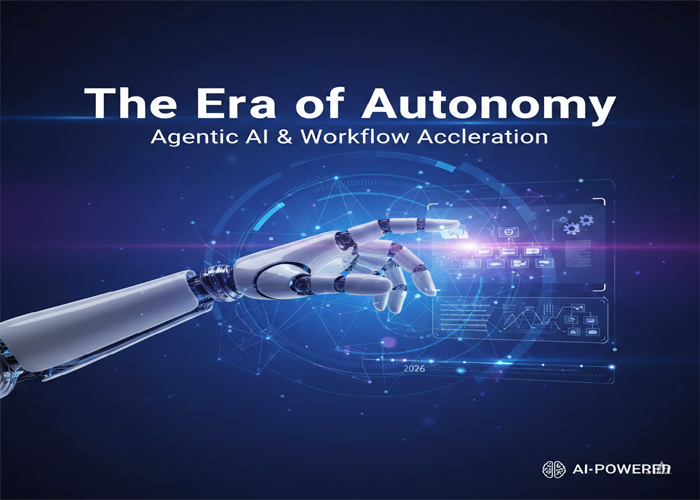
 The Era of Autonomy: How Agentic AI and Continuous Integration are Redefining the Modern Enterprise
In the early 2020s, the world was mesmerized by the "magic" of Generative AI. We marveled at its ability to draft emails, summarize long documents, and create stunning digital art. But as we move through 2026, the novelty has faded, replaced by something far more potent: Agentic AI.
We are no longer just "using" AI; we are orchestrating it. The shift from reactive prompting to autonomous execution marks the most significant structural change in business operations since the dawn of the internet. If 2024 was the year of the chatbot, 2026 is the year of the AI-powered workflow.
To understand the current tech landscape, we must distinguish between the AI we knew and the AI we have now.
Traditional Generative AI is reactive. It waits for a human to type a prompt, provides an output, and then goes dormant. Agentic AI, however, is proactive. When given a high-level goal—such as "optimize our Q3 supply chain for carbon efficiency"—an agentic system doesn't just write a report. It:
Reasons: Breaks the goal into a multi-step plan.
Acts: Accesses APIs, queries databases, and interacts with third-party software.
Self-Corrects: If a vendor is unresponsive, it searches for an alternative without waiting for a human to tell it to do so.
The Structural Shift: From Tools to Middleware
In 2026, agentic AI has become the "new middleware." It sits between your core data and your business outcomes, acting as a coordination fabric. Instead of employees jumping between fifteen different SaaS platforms to complete a single task, AI agents navigate those platforms on our behalf.
The days of six-month "AI implementation cycles" are over. In a competitive market, waiting half a year to deploy a model is a death sentence.
The "AI-Native" Operating Model
Leading firms have moved toward Continuous AI Integration (CAII). Similar to how software developers use CI/CD (Continuous Integration/Continuous Deployment) pipelines, modern businesses now treat their AI models as living organisms that require constant updates and data feeding.
Real-Time Data Loops: AI agents are now connected to live telemetry. Whether it’s factory floor sensors or social media sentiment, the integration is seamless and instantaneous.
Low-Code/No-Code Deployment: You no longer need a PhD in Machine Learning to deploy an agent. Business units—from HR to Finance—are now using "Agent Builders" to automate their own specific niche workflows.
The Rise of Multi-Agent Orchestration
We aren't just deploying one AI; we are deploying "swarms." In a typical 2026 workflow, a Planner Agent might outline a project, a Coder Agent writes the script and a Reviewer Agent audits it for security flaws—all before a human ever sees the first draft.
"Digital friction" refers to the time lost between tasks—the "alt-tabbing" of the modern world. Agentic AI is the ultimate friction-killer.
The "Digital Employee" ROI
Organizations tracking Learning Velocity—the speed at which their autonomous systems improve—are seeing productivity gains of 35% to 55%. This isn't just about doing things faster; it's about doing things that were previously impossible due to human cognitive limits.
With great autonomy comes great responsibility. The "Agentic Gap" is the risk that arises when AI moves faster than a human can audit.
Governance as the New Competitive Moat
In 2026, the most successful companies aren't those with the fastest AI, but those with the best AI Governance.
Explainability (XAI): If an agent denies a loan or changes a procurement contract, the system must provide a "why" that is legally and ethically defensible.
Human-in-the-Loop (HITL): We have moved from humans doing the work to humans supervising the work. The skill of 2026 is not "prompting," but "orchestration."
"The winners of 2026 are not those who automate the fastest, but those who automate with the most transparency and accountability."
As agentic AI becomes deeply woven into the fabric of the enterprise, the line between "the business" and "the technology" is blurring. We are moving toward Physical AI, where these autonomous agents move out of the screen and into our warehouses, labs and cities.
Modernize Your Data: AI agents are only as good as the data they can access. If your data is in silos, your agents are blind.
Focus on Outcomes, Not Tasks: Stop asking "What can AI write for me?" and start asking "What process can AI own for me?"
Build a Trust Layer: Prioritize security and auditability from day one. An autonomous agent without a "kill switch" is a liability.
The rapid integration of agentic AI is no longer a choice—it’s the baseline. In 2026, your competition isn't just other companies; it's other companies powered by hyper-efficient, 24/7 autonomous swarms. The question is no longer if you will integrate AI, but how fast you can turn your "assistant" into your "agent."





💬 Comment Section