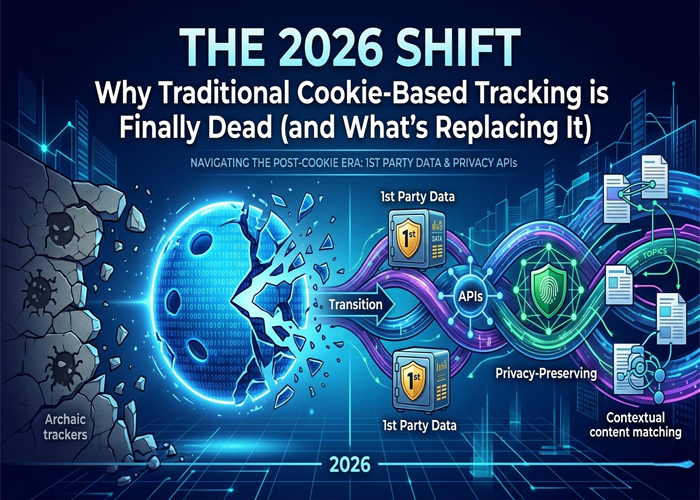
 The 2026 Shift: Why Traditional Cookie-Based Tracking is Finally Dead
For two decades, the "cookie" was the undisputed currency of the internet. It was the silent observer, the digital breadcrumb that allowed advertisers to follow you from a search for "ergonomic chairs" to a news article about space exploration, eventually hitting you with a retargeting ad on Instagram.
But as of 2026, the funeral for the third-party cookie isn't just scheduled—it has already happened. The "Cookie-Pocalypse" that was whispered about for years has culminated in a fundamental shift in how the web functions.
If you are an advertiser, a developer, or a business owner still trying to use 2022 tactics in a 2026 world, you aren’t just behind; you are invisible. This is the definitive guide to the post-cookie era.
The death of the cookie wasn't caused by a single event, but by a "perfect storm" of three converging forces that reached their breaking point in early 2026.
The Regulatory Hammer: Following the blueprint of GDPR and CCPA, new global mandates like the Digital Sovereignty Act of 2025 made "implied consent" illegal. In 2026, if a user hasn't made an active, conscious choice to be tracked, the data cannot be collected.
Hardware-Level Blocking: It’s no longer just about the browser. The latest 2026 smartphone chipsets (like those in the iPhone 17 and Galaxy S26) now feature Silicon-Level Privacy. Tracking requests are intercepted by the hardware before they even reach the OS.
The Consumer Trust Deficit: According to 2026 consumer reports, 84% of internet users now use some form of Privacy-Preserving Tech, ranging from hardened browsers to AI-driven "data scramblers" that feed trackers fake information.
In 2026, the "Golden Rule" of SEO and digital marketing is: If you don't own the relationship, you don't own the data.
The most valuable asset in 2026 isn't what you observe the user doing; it's what they tell you. This is Zero-Party Data.
Interactive Quizzes: "Find your perfect skincare routine" is no longer just a lead magnet; it’s a data-mining goldmine where users voluntarily share their preferences.
Preference Centers: Smart brands now offer "Data Dashboards" where users can toggle exactly what they want the brand to know in exchange for hyper-personalized discounts.
The Newsletter Renaissance
Because you cannot rely on Facebook or Google to "find" your audience anymore, 2026 has seen a massive surge in Owned Media. Private communities, Discord servers and high-value email newsletters have become the primary way to maintain a "warm" audience.
If cookies are dead, what is actually powering the ads we see? The answer lies in Privacy-Preserving APIs and On-Device Processing.
Google’s Privacy Sandbox (The Final Version)
Edge Computing & AI Inference
Clean Rooms
SEO has changed because the intent of the user is now harder to track via cross-site behavior. To rank in 2026, your content strategy must adapt to Information Gain.
Google’s 2026 algorithms are designed to ignore "Refined Content"—articles that simply summarize existing top-10 results. To rank, you must provide:
Original Data: Conduct your own polls or use your own first-party analytics.
Unique Visuals: AI-generated stock photos are being devalued. Real, annotated screenshots and custom diagrams (like the ones in this blog) are the new gold standard.
Voice of Experience: Use "I" and "We." Talk about your specific failures and successes in the courier industry or SEO niche.
Privacy isn't a monolith. In 2026, the "Splinternet" is more apparent than ever.
The EU: The most restrictive. "Contextual Advertising" (ads based purely on the content of the page) has made a massive comeback.
Asia-Pacific: High adoption of "Super-Apps" like WeChat and the 2026 versions of Grab/GoTo. Within these ecosystems, tracking is still high because it is all "First-Party" within the app.
North America: A patchwork of state laws has led to the "Universal Opt-Out" button being built into all 2026 web browsers.
If you are still reliant on old-school tracking pixels, follow this roadmap immediately:
Audit Your Pixels: Remove deprecated third-party tracking scripts that are slowing down your site without providing useful data.
Implement Server-Side GTM: Move your tracking from the browser to your own server. This gives you control over what data is sent to third parties.
Prioritize "The Exchange": Give users a reason to log in. Whether it's a "Voucher Vault" or "Premium Insights," a logged-in user is a trackable user.
Invest in Contextual SEO: Start ranking for keywords that represent the moment of need, not just the persona.
Test Privacy-First Analytics: Switch to tools like Fathom or Plausible that don't use cookies and are fully compliant with 2026 regulations.
The death of traditional cookie tracking is not a tragedy for marketers—it is an opportunity to rebuild trust. In 2026, the brands that win are those that treat user data like a borrowed treasure rather than a resource to be mined.







💬 Comment Section