 Smart Home Goes Autonomous Apple’s Entry and the Wall-Mounted Control Center
For years, the term “smart home” has promised convenience — lights that obey voice commands, thermostats that learn your habits, and doorbells that see who’s at the door before you do. But despite all this progress, the modern smart home still feels fragmented. Every brand has its own app, its own hub, and its own rules.
In 2025, reports of Apple’s wall-mounted smart home control panel — an AI-driven device that merges Siri intelligence, HomeKit integration, and real-time automation — are reshaping the conversation. No longer just “smart,” Apple envisions homes that are autonomous, capable of predicting needs, self-adjusting, and managing themselves with minimal human input.
This blog dives deep into Apple’s rumored entry into the autonomous smart home arena, exploring what this means for users, competitors, and the future of everyday living.
From Smart Homes to Autonomous Homes: The Evolution
Before understanding Apple’s move, it’s essential to grasp how far the smart home industry has come — and where it’s still falling short.
Today’s smart homes rely heavily on user input. You say “Hey Siri, turn off the lights,” or “Alexa, set the temperature to 72.” It’s impressive — but it’s reactive. The home isn’t truly “smart” until it acts on your behalf before you even ask.
That’s where autonomous systems come in. These homes learn from patterns — when you wake up, how you adjust lighting, your comfort temperature — and automatically adapt to your lifestyle.
Brands like Amazon (Alexa), Google (Home), and Samsung (SmartThings) have made huge strides. Yet, each system struggles with fragmentation and privacy concerns. Devices from different brands don’t always talk to each other, and cloud reliance creates vulnerabilities.
Apple’s approach promises to solve both problems — seamless integration and on-device intelligence.
Apple has long flirted with smart home technology through HomeKit and Siri, but its rumored wall-mounted control panel signals a new chapter — one where Apple positions itself as the brains of the autonomous home.
A Glimpse of the Device
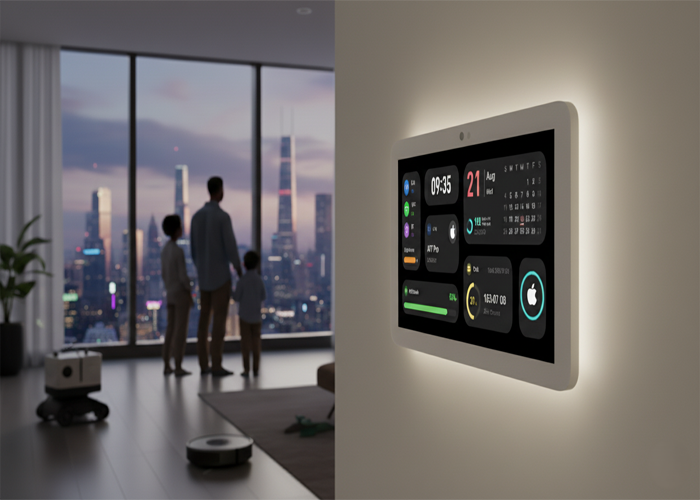
Based on insider reports and industry leaks, Apple’s wall-mounted device is expected to:
Function as a central hub for all HomeKit accessories
Feature a large touchscreen with iOS-like widgets
Integrate AI-driven automation powered by Apple’s Neural Engine
Offer on-device processing for privacy-focused intelligence
Support Face ID and Siri for secure, hands-free control
Imagine walking into your living room and having the system automatically dim lights, start your favorite playlist, and adjust temperature — without a single command.
That’s not a distant dream; it’s the autonomous home Apple envisions.
The Vision: Apple’s Ecosystem Expands Into the Walls
Apple has already conquered the wrist (Apple Watch), the pocket (iPhone), and the desk (Mac). The next logical space is the home itself — and not just through accessories, but through infrastructure.
The wall-mounted control center acts as a brain, connecting all smart devices — lights, locks, cameras, thermostats, and entertainment systems — under one intelligent command network.
Unlike existing smart hubs, which simply relay commands, Apple’s version would use on-device AI to make decisions autonomously. For instance:
If you’re away, it could automatically lock doors and arm security.
If you arrive early, it could preheat the oven or open blinds.
If air quality drops, it could activate purifiers before you notice.
This isn’t automation — it’s anticipation.
Apple’s commitment to privacy gives it a unique advantage. Unlike Google or Amazon, Apple emphasizes local processing. That means your home’s data — your voice, routines, and camera feeds — stay inside your house, not on a cloud server.
In an era of rising data breaches, Apple’s privacy-first philosophy could make it the trusted leader in autonomous home systems.
Design Philosophy: The Wall-Mounted Experience
When Apple designs a product, it doesn’t just think about functionality — it thinks about aesthetics, human interaction, and emotional connection.
Minimalism Meets Utility
The rumored control center resembles a cross between an iPad and a HomePod, but wall-mounted for constant visibility. It would feature:
A thin aluminum frame
Adaptive brightness display
Magnetic mounts for flexible installation
Built-in Siri waveform animation when responding
Apple’s focus on elegant simplicity ensures that the device feels like a natural extension of the home, not another gadget cluttering space.
Home as an Extension of iOS
Apple’s unified design language means the interface will likely resemble iOS — customizable widgets for lighting, temperature, cameras, and scenes.
Users could swipe between “modes” like Morning Routine, Movie Night, or Vacation Mode, each powered by intelligent automation rules.
The brilliance of Apple’s approach lies in context-aware AI — a system that understands why and when to act, not just how.
The wall-mounted panel, paired with sensors and Apple’s ecosystem, could analyze data from multiple sources:
Apple Watch for health and sleep patterns
iPhone for location awareness
HomePod for ambient sound and voice cues
Smart sensors for temperature and motion
By merging these inputs, the system can make real-time adjustments without prompts. For example:
If your Apple Watch detects elevated heart rate during a workout, the system can automatically increase airflow and play energetic music.
Because Apple controls hardware, software and services, it can synchronize every device seamlessly.
Picture this: You’re leaving home, and your iPhone’s location triggers a “Leaving Mode.” Instantly, the wall-mounted control center dims all lights, lowers thermostat settings, and activates HomeKit Secure Video cameras — all autonomously.
This cross-device harmony gives Apple an unmatched advantage in the home automation race.
Apple’s Competitors: The Battle for the Smart Home Brain
Apple’s foray into autonomous smart homes puts it directly against giants like Amazon, Google, and Samsung — but with unique advantages.
Amazon’s Alexa remains dominant in voice control, but it still depends heavily on cloud processing. Privacy and latency issues have slowed its progress toward full autonomy.
Google’s ecosystem excels at prediction and machine learning. However, its reliance on ads and data analytics undermines user trust — an area where Apple thrives.
Samsung leads in appliance integration but struggles with ecosystem consistency. Apple’s control over both software and design gives it a smoother, unified experience.
Apple’s Advantage: Privacy + Integration + Ecosystem
By merging AI intelligence, local processing, and design harmony, Apple may achieve what no competitor has — a truly autonomous, human-centered smart home.
The Role of AI: Homes That Think for Themselves
Apple’s approach to AI isn’t flashy — it’s invisible intelligence. Instead of showing off AI for marketing, Apple integrates it quietly into experiences that just work.
Thanks to Apple Silicon chips (M3 and future A18), AI computation happens directly on the device.
That means your wall-mounted panel can run advanced models — motion detection, face recognition, energy optimization — without sending data to the cloud.
Imagine a home that detects weather changes and adjusts temperature accordingly, or one that knows you’ve had a stressful day (based on health data) and dims lights to help you relax.
That’s the promise of Apple’s contextual AI — understanding human emotion and need without constant instruction.
Apple’s autonomous home model aligns with sustainability goals. Smart energy use — turning off idle devices, optimizing air conditioning, adjusting lighting intensity — reduces waste without effort.
Consumer Reactions: Why People Are Excited
The idea of an Apple-built home control center has sparked massive anticipation online.
Tech enthusiasts highlight several reasons for excitement:
Unified Experience: No more juggling apps — everything works within one clean interface.
Design Aesthetics: Apple products blend naturally into modern homes.
AI Confidence: Apple’s focus on privacy reassures users who’ve hesitated with Amazon or Google.
Future-Proofing: Integration with upcoming Vision Pro, HomePod, and Apple TV devices ensures long-term compatibility.
For many, this is Apple’s chance to make the “smart home” actually feel smart.
Potential Use Cases: Everyday Autonomy
Morning Routine
At 7:00 AM, lights gently brighten, curtains open and your favorite playlist starts. The coffee maker begins brewing automatically — all triggered by your sleep data.
Movie Night
With one tap — or even automatically at sunset — the system dims lights, lowers blinds, activates Apple TV, and sets the temperature for comfort.
Security Mode
When you leave home, doors lock, cameras activate, and you receive a discreet confirmation on your Apple Watch.
Energy Optimization
During peak hours, the system intelligently reduces appliance load to save power while keeping comfort intact.
These examples illustrate a living environment that thinks for you, not just responds to you.
Challenges Ahead: The Path to an Autonomous Future
Even with Apple’s expertise, autonomy in smart homes isn’t without obstacles.
Ecosystem Exclusivity: Apple’s closed ecosystem could limit compatibility with third-party smart devices.
High Cost: Apple’s premium pricing may slow adoption among average consumers.
Installation Complexity: A wall-mounted control system may require professional setup, adding extra expense.
AI Regulation: As AI autonomy grows, new privacy laws could impact how much intelligence the home can exercise without explicit consent.
Still, Apple’s track record suggests it will prioritize user trust, simplicity, and integration — just as it did with iPhone and Apple Watch.
The Future of Apple’s Smart Home: What Comes Next
If Apple’s wall-mounted control center launches successfully, it could mark the beginning of an entire home ecosystem designed by Apple.
Vision Pro Integration: Augmented reality control of home environments
Apple Energy Services: Smart grid optimization through AI learning
AI-Driven Maintenance: Predictive alerts for device or system malfunctions
Multi-Home Management: Seamless control for users managing multiple residences
In the long term, Apple could evolve from a device company into a lifestyle infrastructure provider — one that designs not just your gadgets, but your entire living environment.
Apple’s rumored wall-mounted control center isn’t just another gadget; it’s a gateway to autonomous living.
By merging AI, design, and privacy, Apple is pushing the smart home beyond convenience into the realm of self-sufficiency.
The era of telling your home what to do is ending.
The era of your home knowing what you need — before you ask — is just beginning.
In a world racing toward automation, Apple’s entry might not only redefine smart homes — it might redefine how we live within them.




💬 Comment Section