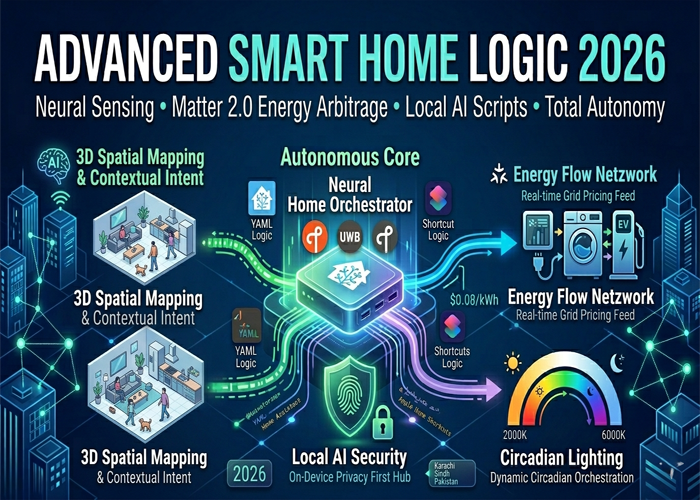
 Smart Home Autonomous Modes: Setting Up a No Input Household
The era of "Hey Google, turn on the lights" is officially over. In 2026, a truly smart home doesn't wait for your command; it anticipates your presence. We are moving from Reactive Smart Homes to Autonomous Ecosystems.
A "No-Input" household is a home where the apps are deleted, the voice commands are silenced, and the environment adjusts itself through a digital fabric of mmWave presence sensing, AI-driven intent recognition, and the fully matured Matter 2.0 protocol.
In 2025, we were still tethered to our phones. In 2026, the smartphone has been relegated to a setup tool. The core of the autonomous home is the Home Orchestrator.
The difference between a "smart" routine and an "autonomous" mode is the trigger.
Old Way (Reactive): A motion sensor sees you and turns the light on for 5 minutes.
New Way (Autonomous): A mmWave presence sensor (like the Aqara FP400) detects the micro-movements of your breathing. It knows you are sitting on the couch reading, not just walking through. It keeps the lights on, adjusts the color temperature to a warm 2700K, and slightly increases the HVAC fan speed to maintain CO2 levels—all without a single word from you.
If you’re building an autonomous home in 2026, your foundation must be Matter over Thread.
Earlier versions of Matter focused on "Can these devices talk?" Matter 2.0 (and the 1.6/1.7 updates) focuses on "How do they work together intelligently?"
Device Energy Management (DEM): Your appliances (washers, dishwashers, EV chargers) now fetch grid price schedules directly. An autonomous home pauses a drying cycle if the local utility hits a "Peak Price" window, resuming automatically when rates drop.
Spatial Awareness: Using the Aliro standard and Ultra-Wideband (UWB), your home knows exactly where you are. As you move from the kitchen to the bedroom, your "Audio Shadow" (your music or podcast) follows you from speaker to speaker with centimeter-level precision.
Local AI Processing: The cloud is now a backup. In 2026, your Home Orchestrator processes your habits locally. This means your data never leaves your four walls, and your house stays autonomous even if the internet goes down.
To achieve a "No-Input" household, you must think in Zones, not devices.
Forget keys or fingerprint pads. 2026 is about UWB Hands-Free Entry.
The Tech: A UWB-enabled smart lock (like the Lockin V7 Max) detects your phone or watch in your pocket as you reach the porch.
The Autonomy: The door unlocks, the security system disarms, and the "Coming Home" scene triggers—lighting the hallway and setting the thermostat to your preferred "Active" temperature—before you even touch the handle.
Traditional PIR motion sensors are the "No-Input" enemy because they turn off when you sit still.
The Tech: mmWave Presence Sensors. These can track up to 10 people simultaneously and distinguish between a human, a dog and a robot vacuum.
The Autonomy: The room knows if you are watching a movie (dimming lights, closing blinds) or exercising (dropping the temp by 2 degrees and increasing air purification).
An autonomous bedroom doesn't need an alarm clock.
The Tech: Sleep sensors integrated into the mattress or wall-mounted mmWave sensors.
The Autonomy: As you enter "Deep Sleep," the house enters "Deep Quiet" mode—locking all exterior doors, lowering the HVAC to 18°C, and disabling all non-essential notifications. 30 minutes before your natural wake cycle (based on your REM stages), the blinds gradually open 10% to let in natural light.
| Category | Recommended 2026 Hardware | Key Autonomous Feature |
| Orchestrator | Home Assistant Green 2 / Apple HomePod Ultra | Full local AI intent processing |
| Sensing | Aqara Spatial Multi-Sensor FP400 | mmWave tracking for 10+ people |
| Climate | Ecobee Smart Thermostat Premium (2026 Ed.) | Predictive HVAC based on weather & occupancy |
| Lighting | Philips Hue Bridge Pro + Gradient Strips | Spatial Aware lighting that follows movement |
| Power | EcoFlow PowerInsight 2 | Automated grid-to-battery load shifting |
The hardest part of a "No-Input" household isn't the technology—it’s the Logic Conflicts.
Example: What if you’re reading on the couch but your partner wants to nap?
If you already have a "Smart Home" here is how to upgrade it to "Autonomous" status:
Replace PIR with mmWave: Start with your most-used room. Replace your old motion sensors with mmWave presence sensors to eliminate "False Offs."
Consolidate to a Local Hub: Move away from cloud-dependent apps. Use a Matter-certified hub that supports Local Automations.
Enable "Predictive Energy" Connect your smart meter to your orchestrator. Let the house decide when to run the dishwasher.
Silence the Voice: Remove your dependence on voice commands for 7 days. If you find yourself needing to "Ask" for a light, your automation logic is incomplete. Fix the trigger, don't repeat the command.
In 2026, the highest luxury isn't a house that listens—it’s a house that knows. A "No-Input" household returns your mental bandwidth to you. You stop managing your home, and your home starts managing itself.
As we look toward 2027, the line between the "Digital" and "Physical" world will continue to blur. The pioneers of today’s autonomous modes are the residents of tomorrow’s living ecosystems.




💬 Comment Section