 ? Education in Future: The Dawn of AI Tutors and Personalized Learning for All
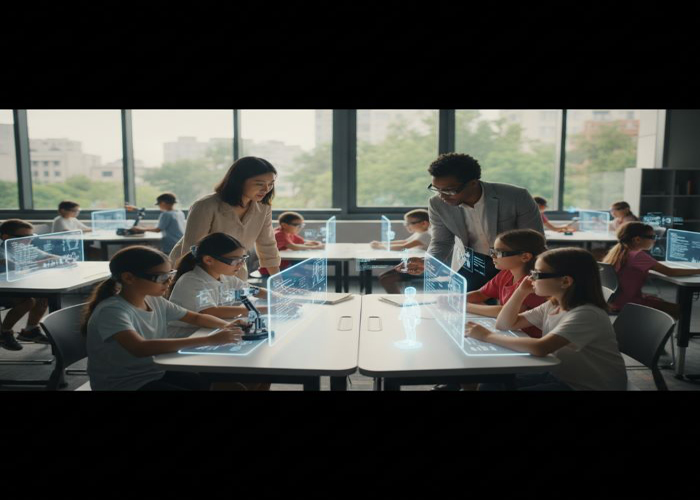
The classroom of the 20th century—a static room with a single teacher lecturing to two dozen students—is finally yielding to its successor. By 2026, the global education landscape will have undergone a seismic shift, driven not by new curricula or standardized tests, but by the relentless, adaptive intelligence of Artificial Intelligence. This transformation is giving rise to two intertwined concepts that are redefining learning: Intelligent AI Tutors and Truly Personalized Learning Pathways.
This is not a future where robots replace teachers; it is a future where teachers, empowered by digital partners, are finally freed to do the high-value, human work they were meant to do: mentoring, coaching, and inspiring critical thought. The year 2026 marks the moment when this vision transitions from pilot program to pervasive reality, offering the promise of educational equity and tailored success for every learner on the planet.
For generations, education has been constrained by the limitations of scale. A single human teacher cannot simultaneously address the unique cognitive pace, preferred sensory input, and emotional state of thirty different students. Personalized learning, once an aspirational buzzword, is now achievable at scale, courtesy of intelligent systems.

The foundational shift in 2026 is the network’s ability to move beyond simple differentiation and create Adaptive Learning Ecosystems (ALE). These systems ingest data points far beyond simple test scores—analyzing everything from a student’s completion time on a simulation, their engagement with a specific type of video, their input on a discussion forum, and even their emotional tone in an AI-tutor conversation.
This data is then used to construct a dynamic, ever-changing curriculum called a Personalized Learning Pathway (PLP).
For the Visual Learner: A PLP might prioritize interactive 3D simulations, virtual reality (VR) field trips into historical periods or complex, manipulable diagrams to explain abstract physics concepts.
For the Kinetic Learner: The pathway might feature gamified learning modules, project-based assignments involving physical construction or coding and AI-guided role-playing scenarios.
For the Auditory Learner: The system might deliver personalized micro-podcasts or use the AI tutor to engage in Socratic dialogue and debate complex ideas orally.
The core insight here is that the system doesn't just recognize a student’s current score; it anticipates their next failure point, intervenes with the exact resource needed, and adapts the complexity of the material in real-time to maintain the perfect balance between challenge and achievability, a concept psychologists call the "Zone of Proximal Development."
Micro-Credentialing and the Modular Future
As learning becomes hyper-personalized, the monolithic degree or diploma of the past is starting to fragment. By 2026, micro-credentials and digital badges confirmed on secure, decentralized ledgers (like blockchain) are gaining significant traction.
Students are no longer defined solely by their four-year degree but by a portfolio of verified, high-granularity skills. The AI tutor can identify a specific skill gap—for instance, "Advanced Python Debugging" or "Ethical Data Interpretation"—and recommend a short, personalized module that, upon completion, issues a verifiable micro-credential. This shift is crucial for:
Workforce Readiness: Employers can now instantly verify a candidate’s practical competence in ultra-specific, high-demand skills.
Lifelong Learning: Professionals can rapidly reskill or upskill without committing to a full academic program, making continuous education a seamless part of their career.
The most transformative element in the 2026 classroom is the Intelligent Tutoring System (ITS), often dubbed the "AI Tutor." This is far more sophisticated than the simple chatbot of 2024. Fueled by advancements in large language models (LLMs) and sophisticated domain-specific knowledge graphs, the AI Tutor is becoming a scalable, tireless, and hyper-competent private instructor available 24/7.

The modern AI Tutor excels at simulating high-quality, one-on-one human coaching:
Socratic Dialogue: The best AI Tutors engage students not just by answering questions, but by asking them. They use targeted questions to diagnose the root cause of a student’s misunderstanding, encouraging active retrieval and critical thinking rather than passive information reception.
Real-Time Feedback Loop: If a student submits a practice essay, the AI provides immediate, multi-layered feedback: suggestions on structure, grammar corrections and most importantly, analysis of the quality of argumentation and citation ethics. This near-instantaneous feedback drastically shortens the learning curve.
The Emotional Gauge: Using advanced natural language processing (NLP) to analyze text and voice inputs, the AI can often infer a student's emotional state—frustration, confusion, or enthusiasm. If the system detects acute frustration, it may autonomously pivot from complex problem-solving to a simpler conceptual review or even suggest a five-minute "brain break." This is the core of AI affective computing applied to education.
Democratizing Excellence
In the traditional system, access to a top-tier tutor was a privilege. In 2026, the AI Tutor fundamentally shifts the equity equation. Students in under-resourced schools, rural areas, or developing nations can access personalized, expert-level instruction equivalent to what was once reserved for the wealthy. This scalability is the engine of global educational opportunity, offering:
Language Barrier Removal: Real-time translation and content generation allow students to engage with global course materials in their native language, breaking down linguistic and geographic barriers.
Support for Special Needs: AI Tutors are uniquely patient and adaptable, offering infinitely repeated explanations and non-judgmental support, which is invaluable for neurodiverse learners or those with specific learning disabilities.
The arrival of the AI Tutor does not diminish the teacher; it elevates their profession. By 2026, the teacher's role is shifting dramatically from "information provider" to Chief Learning Strategist, Mentor and Coach.

The most significant immediate benefit of AI for teachers is the automation of administrative and low-leverage tasks:
Instant Grading: AI systems handle the grading of standardized quizzes, math problems and even first drafts of essays, instantly freeing up hours per week.
Data Synthesis: Instead of manually tracking progress, teachers receive sophisticated, AI-generated dashboard insights that instantly flag students who are either excelling and need more challenge or struggling and need human intervention.
Lesson Creation: Generative AI tools allow teachers to input a topic, a grade level, and a learning style preference and instantly receive customized worksheets, discussion prompts or assessment questions, multiplying their planning efficiency by orders of magnitude.
Freed from drudgery, the teacher's new focus is on developing the uniquely human skills that AI cannot replicate:
Emotional Intelligence (EQ): Teachers focus on social-emotional learning, conflict resolution, team-building and fostering the intrinsic motivation that drives lifelong curiosity.
Critical Thinking and Ethical Debate: The classroom becomes a vibrant forum for high-level discussion, ethical dilemmas and complex, ambiguous problem-solving—skills that require human mentorship and nuanced feedback.
Curation and Context: The teacher’s new expertise lies in curating the right AI tools for the right student at the right time and providing the real-world context and ethical framework for using the knowledge acquired.
The powerful transformation wrought by AI in education is not without risk. For the promise of 2026 to be realized responsibly, critical ethical and governance challenges must be proactively addressed.

The foundation of personalized learning is data. The more granular the data on a student's performance, behavior and emotional state, the better the personalization. This creates a massive privacy challenge:
Who owns the data? Students and parents must have clear rights and control over their learning data.
Security Risks: The centralized nature of these systems makes them prime targets for cyberattacks. Robust, quantum-safe encryption and decentralized data storage models are becoming mandatory.
The Autonomy Question: Does a constantly adapting system, designed to nudge a student toward the most efficient learning path, infringe on their autonomy or reduce their exposure to productive struggle and independent discovery?
AI is only as unbiased as the data it is trained on. If AI models are built using historical data that reflects systemic bias—for example, if they underperform in recognizing the speech patterns or cultural contexts of a minority group—they risk amplifying educational inequality.
The industry is urgently focused on Bias Audits and deploying Explainable AI (XAI), systems that can clearly articulate why they made a specific decision. This transparency is crucial for ensuring that AI tutors do not inadvertently guide certain demographics toward lower-opportunity pathways. Equity in 2026 requires not just access to AI, but access to unbiased, high-quality AI.
The Crisis of Academic Integrity
Generative AI’s ability to produce complex, human-like essays and code presents an existential threat to traditional assessment. By 2026, the emphasis has shifted dramatically from product-based assessment (the final paper) to process-based assessment (the journey of learning).
Focus on Skills: Assignments are now designed to test uniquely human skills—synthesis, critique of AI output, ethical judgment and complex, real-world application—that cannot be automated.
Adaptive Testing: AI-driven adaptive tests are replacing static exams, where every question is tailored in real-time based on the student's previous answers, making cheating via pre-shared answers impossible.
The year 2026 will be remembered as the inflection point where the potential of AI finally converged with the profound needs of global education. The barrier of scale is broken; the luxury of personalization is democratized.
The true revolution is not the technology itself, but the renewed focus on the human element it enables. With AI Tutors providing the foundation of personalized mastery and data-driven feedback, teachers are empowered to be the catalysts for creativity, critical thinking, and the emotional resilience that defines human potential. The future of education is not simply digital; it is deeply, dynamically, and individually human, ensuring that every student, regardless of background, has a tailor-made pathway to realizing their fullest potential.



💬 Comment Section